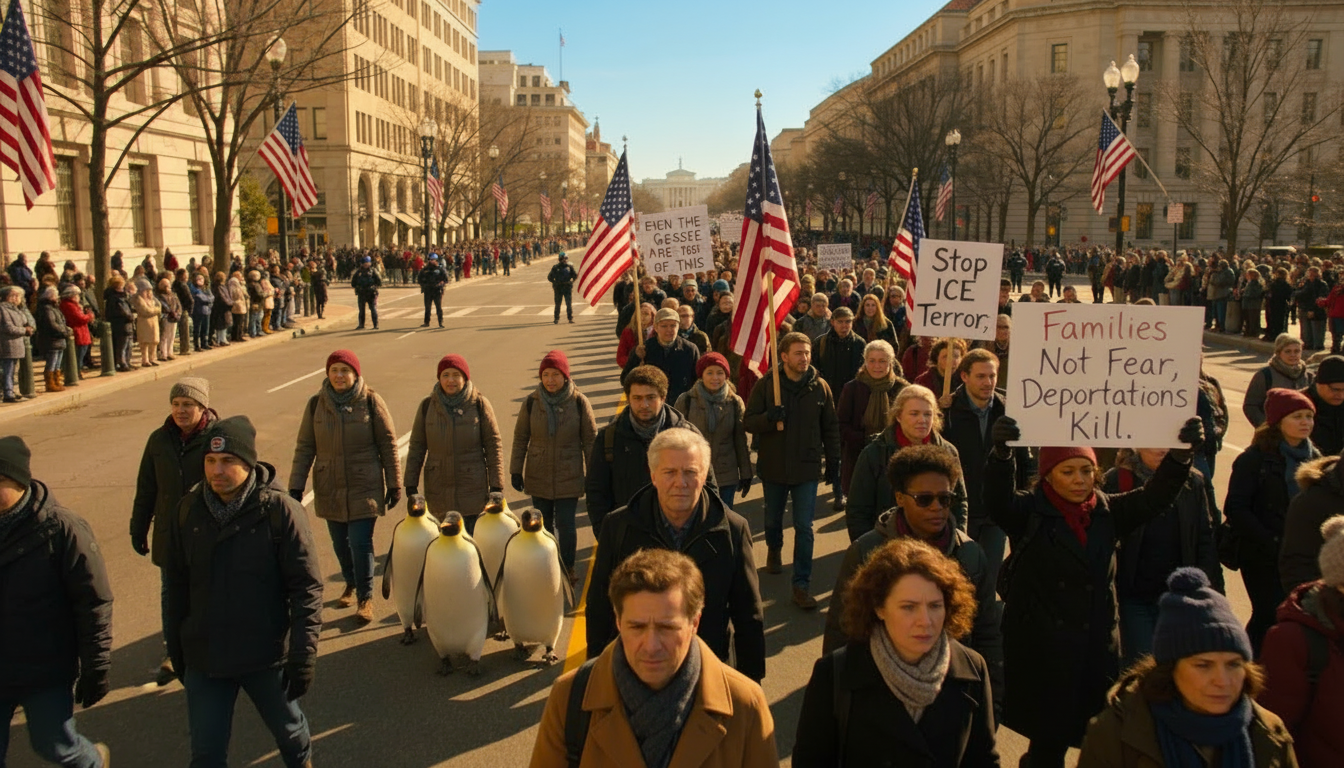
America's protesters have marched for everything under the sun since 2014, often over causes that left observers scratching their heads. Now, with over 300 anti-ICE demonstrations sweeping the country in early 2026 amid aggressive deportation raids and fatal shootings by agents, the nation nods in agreement: this one's got merit.[1][2][3]
2014: Defund the Police
The first major Defund the Police marches erupted in 2014 following high-profile police killings, setting off over a decade of relentless activism. These early rallies demanded systemic reform but often devolved into chaos. Large-scale protest energy around policing and systemic injustice had surged into a lasting civic mode, the kind where “weekend plans” became “meet downtown, bring water, scream politely.” The motivations were serious, but probably aren’t anymore. [4] [55]
2017: Marches for Women, Race, Religion
Women's Marches drew millions on January 21, the day after Trump's inauguration, protesting misogyny and policy threats. Why does he hate women? Racial justice and religious freedom marches followed and probably will regardless of what happens because the people feel these issues are “still like a thing.” All this was blending noble intents with pink hats and fervent chants that sometimes overshadowed core issues, but what a fabulous frenzy.[5][6]
2018: Guns, Nicaragua, and 6,000+ Events
Over 1 million joined March for Our Lives against gun violence after Parkland, one of the largest youth protests ever. Americans then (in a trend that would repeat itself in 2025) became very concerned with Nicaragua's brutal crackdown adding international flair to an otherwise bland fit, amid a record-smashing 6,000+ US actions that month alone.[7][8][9][10]
2019: Women's Marches Persist, Feds and Hong Kong
Third Women's Marches rallied millions, while fears of Fed funding cuts to sanctuary states sparked outrage. Straight white men were seen taking the weekend out on the lake. October saw millions more protesting broadly; China accused the US of fueling Hong Kong protest. "As you all know, they are somehow the work of the US,” spokeswoman Hua Chunying told reporters at a press briefing in Beijing. Supposedly, that is a real quote.[11][12][13]
2020: George Floyd
George Floyd protests exploded nationwide, with up to 500,000 in DC alone. George Floyd protests became one of the largest protest movements in US history, spreading nationwide with a scale and intensity that reset the decade’s attention. Amid the fury, a deceptively small phrase captured the demand: “Just be fair,” which reads like a gentle request until you realize it’s being shouted from a society that can’t even agree on what “fair” looks like in practice.[64][61]
Seattle's then-Mayor Jenny Durkan reminisced about her participation in the protests against the wars in Vietnam, urging calm amid the summer of riots —an attempt to connect past protest legitimacy to present-day turmoil, and also to remind everyone that today’s officials were once the people yelling at officials.[43][14][15][16][11]
2021: January 6 Capitol Storm
Supporters of Trump stormed the Capitol on January 6, clashing with barriers in a spectacle that flipped the protest script. Hundreds breached the building, marking a wild pivot from street marches to siege. 2021’s defining political shock, a mass action that used the aesthetics of a rally and the tactics of an assault, remains a hinge point in modern America: a grim demonstration of how quickly “demonstration” can turn into “insurrection,” depending on whether it was decaf or f*cking crank.[44][17]
2022: Dobbs, inflation anger, and the small-crowd culture war
In 2022, the Supreme Court’s decision in Dobbs v. Jackson triggered widespread protests over abortion rights, reframing the country’s political and cultural fault lines in a single, devastating stroke, particularly for demographics completely unaffected by abortion issues. Research and analysis from that period emphasized abortion’s outsized role in political behavior relative to inflation, even as inflation anger simmered.[45] At the same time, antigovernment protests tied to inflation and economic strain were part of a broader global pattern tracked by the Carnegie Endowment for International Peace, which documents protest drivers and waves across countries. The message was consistent: people can tolerate many things, but if you give a mouse a cookie it’s going to want a glass of milk and where’s my stimulus check?[46] Also in the mix were right-wing activist efforts to deliver anti-transgender messaging; these events occurred in the wider protest ecosystem but generally did not match the crowd sizes seen for abortion rights, racial justice, or major national crises. Trying to confuse the children isn’t a big deal. [47][46]
2023: Palestine rallies, cost-of-living anger, and climate action—simultaneously, of course
By 2023, the protest landscape reflected overlapping crises and causes: pro-Palestine rallies in the US intensified, mostly from men and women who heard about something on the internet and especially as the Israel–Gaza war erupted in October and demonstrations surged afterward. Civic space monitors documented increased protest activity and related arrests and restrictions, capturing how quickly street politics can escalate into a governance problem.[48]
2024: Gaza Encampments
Gaza solidarity protests peaked at Columbia and UCLA, with nearly 12,400 pro-Palestine and 2,000 pro-Israel events from late 2023 to mid-2024. Biden briefs reporters, "Protesters have no right to 'cause chaos'," and claims he does not want to send in the National Guard, “Because my hearing aid keeps picking up signals from their new acoustic weapons.”[21][22]
2025: The No Kings
The "No Kings" campaign blasted Trump's administration for authoritarianism and corruption, drawing 2-4.8 million across 2,100+ sites on June 14. In 2025, the “No Kings” anti-authoritarian campaign wasn’t just a generic waste of something to complain about, it framed itself as opposition to corruption and executive overreach in the Trump Administration, using the language of monarchy as a shorthand for democratic backsliding. Analyses and protest data reporting described it as one of the largest single-day protest mobilizations in US history, notable for its geographic spread and turnout estimates. [50][51][23][24]
2026: Anti-ICE Protests
Over 300 anti-ICE protests rocked cities from Minneapolis to LA on January 31, triggered by agent shootings like Renee Good's and mass deportations. Unlike prior absurdities, these rallies against federal overreach and fatalities are refreshingly justified.[2][25][3][8][1]